
Ari Tjahjanto - SEA Case Study


About Ari Tjahjanto: Building Strong Systems Through People, Policy, Technology, and Experience. 
A seasoned business leader with over 25 years in ISP and Telco, Ari Tjahjanto has held leadership roles across customer service, corporate strategy, sustainability, human capital, and network quality at leading companies including XL Axiata and other major telecommunications providers. Guided by his PPTX framework (People, Policy/Process, Technology, and Experience), Ari focuses on strengthening organizational foundations, improving employee and customer journeys, and embedding service design into every stage. His leadership philosophy is simple yet powerful: make your team successful, and success will follow.

What brought you to this moment in your career where the Sustainability Excellence Associate (SEA) made sense for you?


After more than two decades of leadership across diverse functions — from corporate strategy, Telco Network and IT to HR and sustainability — I recognized the need to formally strengthen my expertise in sustainable finance and development. Pursuing the SEA certification from ISSP aligned perfectly with my academic journey at Udayana University in Sustainable Finance & Development, and it became a strategic step to bridge my leadership experience with globally recognized sustainability standards. The SEA credential provided a structured and credible framework to integrate sustainability principles into my advisory, teaching, and authorship work.


How are you putting the knowledge, skills, and ability demonstrated in the SEA to work in your career (or work) today?


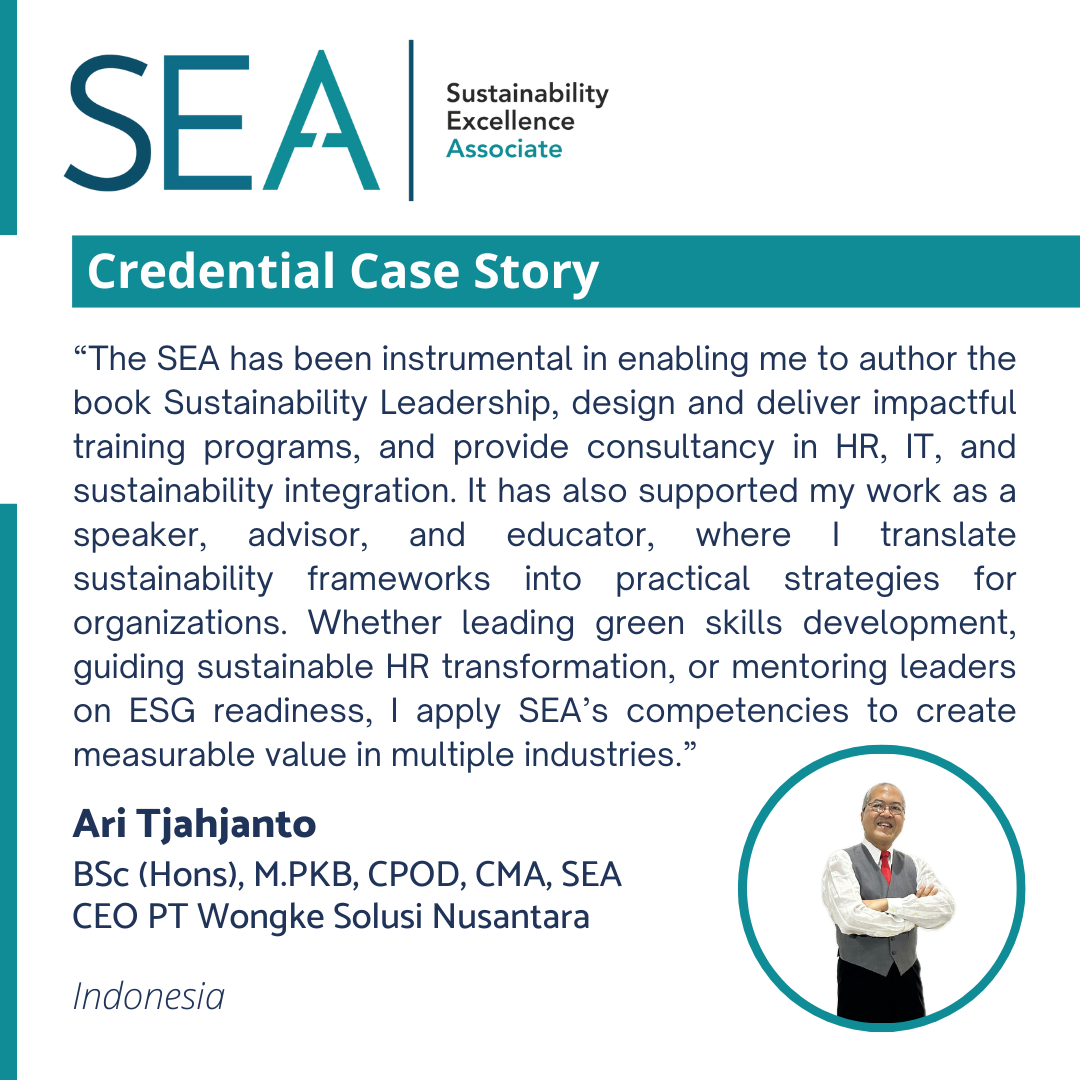
The SEA has been instrumental in enabling me to author the book Sustainability Leadership, design and deliver impactful training programs, and provide consultancy in HR, IT, and sustainability integration. It has also supported my work as a speaker, advisor, and educator, where I translate sustainability frameworks into practical strategies for organizations. Whether leading green skills development, guiding sustainable HR transformation, or mentoring leaders on ESG readiness, I apply SEA’s competencies to create measurable value in multiple industries.


For those starting out in the sustainability field, what advice do you have for them?


Start with a growth mindset since sustainability is a dynamic and evolving discipline that demands continuous learning. Don’t be afraid to explore beyond your immediate expertise, because sustainability connects finance, technology, operations, and people. Keep expanding your knowledge, stay curious, and seek out certifications and experiences that will give you both technical competence and strategic perspective. And most importantly, remember that your role is not only to meet today’s standards, but to inspire and lead change for the future.


Read perspectives from the ISSP blog

By By Elizabeth Dinschel & Bangaly Kourouma January 16, 2026
January 16, 2026 At the International Society of Sustainability Professionals (ISSP), strategy is not theoretical. It is practical, action-oriented, and grounded in the real needs of sustainability professionals working in complex and rapidly evolving environments. The ISSP 2026 Strategic Plan is a one-year, execution-focused roadmap designed to strengthen ISSP’s role as a global professional association for sustainability practitioners. Built directly from member feedback gathered through Town Halls, surveys, and ongoing conversations, the plan focuses on three strategic priorities: financial stability, relevant professional knowledge, and meaningful member engagement. This article explains what the 2026 Strategic Plan is, why these priorities matter, and how member input directly shaped ISSP’s direction. What the ISSP 2026 Strategic Plan Is—and Is Not The 2026 Strategic Plan is not a long-term vision statement or a five-year forecast. It is a focused, one-year plan designed to deliver measurable progress. The plan is intended to: Strengthen ISSP’s financial sustainability Modernize sustainability education and credential resources Improve the member experience across career stages Each priority includes defined actions, timelines, and success metrics, ensuring accountability and transparency.
Paper cut-out figures holding hands in a chain against a dark blue background.
By Elizabeth Dinschel, December 18, 2025 December 18, 2025
Elizabeth Dinschel, MA, MBA, is the Executive Director of ISSP Earlier this month, we hosted our first global ISSP Town Hall since I stepped into the role of Executive Director. I logged off that call energized, humbled, and deeply grateful for the honesty, generosity, and care that our members brought into the space. This Town Hall was never meant to be a one-way update. It was designed as a listening session — a chance for ISSP leadership and staff to hear directly from sustainability professionals across regions, sectors, and career stages. And you delivered. What follows are a few reflections on what I heard, what we learned, and where we’re headed next together. Why We Called This Town Hall ISSP has gone through a period of transition — new leadership, new staff, and a renewed focus on modernizing how we serve a truly global membership. Change can be energizing, but it can also create moments of uncertainty and disconnection. We knew we needed to pause, gather our community, and listen with intention. The Town Hall brought together members from multiple continents, industries, and disciplines. Sustainability practitioners, consultants, engineers, communicators, policy professionals, and career-transitioners all showed up with thoughtful questions and candid feedback. One thing was immediately clear: this community cares deeply about its work, about each other, and about ISSP’s role in supporting sustainability professionals at a challenging moment for the field.
Can sustainability be saved by tackling loneliness, not just CO₂ emissions?
By Raz Godelnik, Associate Professor November 20, 2025
Raz Godelnik is an Associate Professor of Strategic Design and Management at Parsons School of Design — The New School. He is the author of Rethinking Corporate Sustainability in the Era of Climate Crisis . You can follow him on LinkedIn .  Can sustainability be saved by tackling loneliness, not just CO₂ emissions? Earlier this month, I stopped at Sunshine Coffee in Laramie, Wyoming, on our way to Yellowstone Park. What brought me there was the fact that it’s a zero-waste coffee shop, with no single-use consumer items. In other words, there are no disposable cups — not for customers dining in, and not even for those who want their coffee to go, like I did. Instead, you can either bring your own reusable cup or get your drink in a glass jar for $1, which is refunded on your next order when you return it (or you can simply keep it, as I did). At first, I was excited about the zero-waste coffee shop concept, wondering what it would take for Starbucks and other coffee chains to adopt it and eliminate the waste that has become an integral part of our coffee (and other drinks) consumption. But as I waited for my coffee, I began to notice something else — something that had little to do with waste and everything to do with people. As I looked around, I noticed their stickers. Beneath the logo, it read: Zero waste. Community space . Suddenly it clicked — this coffee shop isn’t just about eliminating waste; it’s about creating a place where people feel connected. As owner and founder of Sunshine Coffee, Megan Johnson, explained in an interview with This is Laramie : “I wanted to bring sustainable values to Wyoming as well as build a business that serves the community.” That got me thinking about how the second part — serving the community — is integral to the first. After all, in a world where loneliness — a key barrier to people’s well-being — is on the rise, shouldn’t creating spaces for connection be just as central to sustainability as going zero waste?
More blog posts