Elizabeth Cockle - SEA Case Story

About Elizabeth:  A natural storyteller, committed to creating a more sustainable future, Elizabeth has built her career on the ability to blend strategic marketing with sustainability, ESG and hot topic issues. She is known for crafting content that resonates with diverse audiences and driving initiatives that amplify brand visibility and engagement. Over her career she has built a reputation for her strategic, results-driven approach from increasing brand awareness through creative marketing campaigns, drafting reports and speeches on complex issues, and advising on cross-functional communication projects from start to finish.


What brought you to this moment in your career where the Sustainability Excellence Associate (SEA) made sense for you?


Growing up, I was the weird kid whose school lunches were packed in rinsed-out milk bags and empty cookie bags because my mom was passionate about reducing waste. I also loved writing stories. So it made sense that environmental purpose and storytelling would shape my career. 


As a communications professional, I have worn many hats: scientific and medical editor, professional services marketer, back-cover copywriter for romance novels. Throughout these shifts, I kept finding my way to sustainability-related projects, such as editing watershed management plans for Toronto and Region Conservation Authority, creating a content marketing campaign for a restoration company on protecting homes and commercial property from climate disasters, and editing reports on the financial impacts of climate change on provincial infrastructure, which introduced me to the critical work of the Intergovernmental Panel on Climate Change.


I was motivated to pursue the SEA by realizing I want my career to more deeply align with my values and interests. My most fulfilling role was working as a communications consultant for an engineering firm specialized in decarbonization retrofits. I really enjoyed wrapping my head around how chillers and heat pumps function, and how HVAC systems in hospitals, office buildings and across campuses can be optimized to cut energy costs while also significantly reducing GHG emissions. Complex information like this must be distilled into digestible content for non-engineers and other stakeholders to build the business case for a deep energy retrofit. The same applies for any sustainability initiative or climate solution. 


How are you putting the knowledge, skills, and ability demonstrated in the SEA to work in your career (or work) today?


Through the SEA I learned the concepts, trends and history of sustainability, which is essential for demonstrating broad climate fluency. This knowledge means I can communicate the benefits of corporate sustainability initiatives and speak confidently with clients, subject matter experts, stakeholders and at business events—including about the alphabet soup of reporting frameworks (GRI, CDP, IFRS S1/S2, SASB, SDG, TCFD/TNFD).


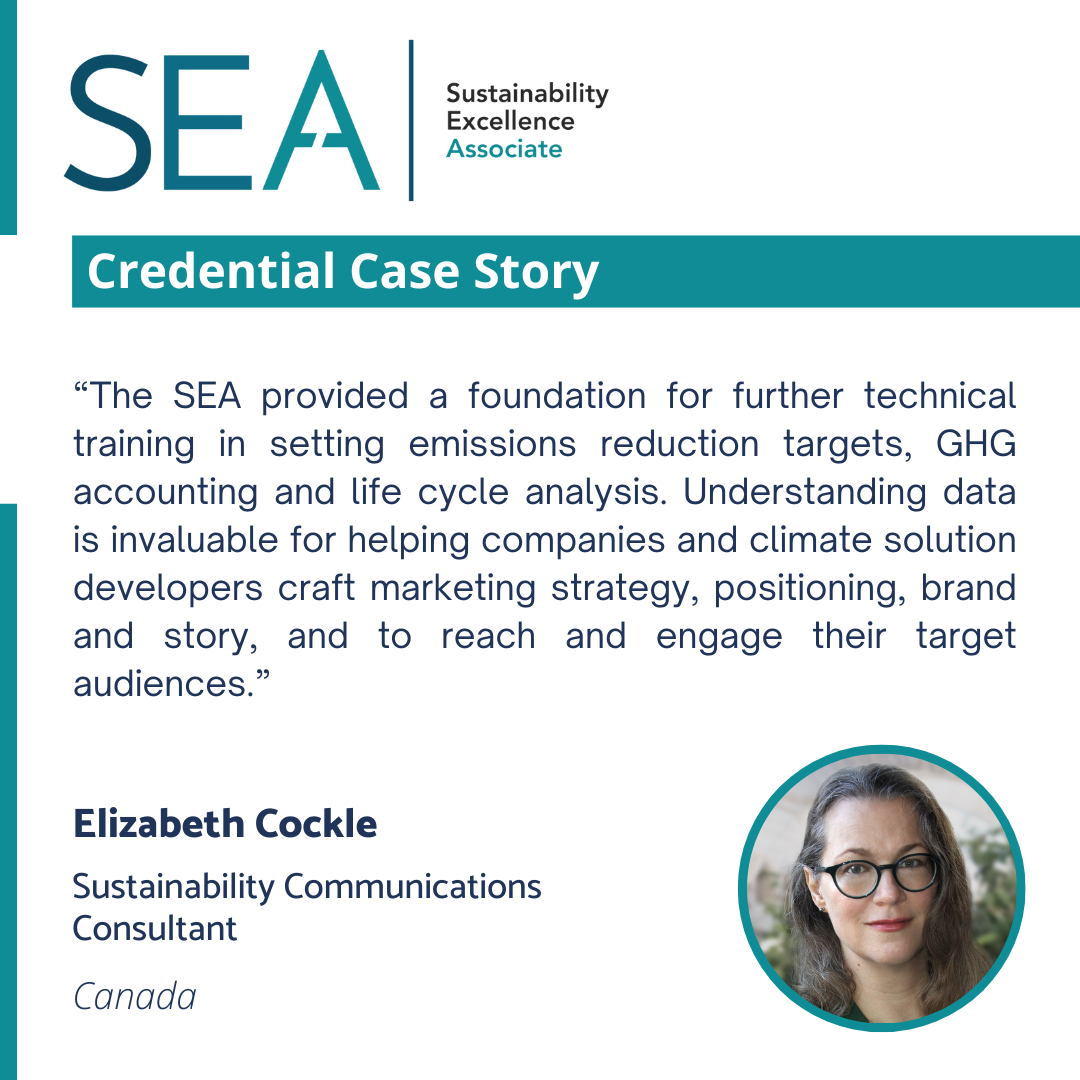
As well, the SEA provided a foundation for further technical training in setting emissions reduction targets, GHG accounting and life cycle analysis. Understanding data is invaluable for helping companies and climate solution developers craft marketing strategy, positioning, brand and story, and to reach and engage their target audiences. Plus I can nerd out with data people.


The SEA opened my eyes to the social justice aspects of sustainability and how addressing societal inequity and unequal distribution of resources contributes to a greener, better future. Recently I’ve had opportunities to assist a non-profit that helps veterans adjust to civilian life, and to consult on and contribute to We’ve Got Some Things to Say: Reshaping Narratives Around Sexual Violence, an anthology published by Amherst Writers & Artists Press.


For those starting out in the sustainability field, what advice do you have for them?


For those new to sustainability, stay curious and keep learning. Stay updated on emerging research, technoLearn as much as you can, through courses, podcasts, books, newsletters. The information is out there, and technologies are constantly evolving. Green skills are becoming embedded in job titles that don’t necessarily contain “sustainability.”


Understand how sustainability initiatives are tied to revenue. As certain industry language falls out of favour due to political changes, focus on how energy efficiency saves money, progress and transparency strengthen brand value, and a resilient supply chain is good for business. Also keep in mind that doom-and-gloom messaging incites fear and avoidance. Inspire action by emphasizing hope and benefits. 


Get involved with ISSP. The monthly webinars, working sessions and networking events are excellent ways to stay current and connect with members all over the world. If you plan to earn the SEA credential, I highly recommend joining a study cohort. The group discussions and extra content made a huge difference, as did the community. Shout-out to my super-talented, super-committed cohort members, who are going on to do great things! 


Interested in earning your SEA credential? Download our free sample of the SEA Study Guide or sign up for the next SEA Study Cohort.

Read perspectives from the ISSP blog

By By Elizabeth Dinschel & Bangaly Kourouma January 16, 2026
January 16, 2026 At the International Society of Sustainability Professionals (ISSP), strategy is not theoretical. It is practical, action-oriented, and grounded in the real needs of sustainability professionals working in complex and rapidly evolving environments. The ISSP 2026 Strategic Plan is a one-year, execution-focused roadmap designed to strengthen ISSP’s role as a global professional association for sustainability practitioners. Built directly from member feedback gathered through Town Halls, surveys, and ongoing conversations, the plan focuses on three strategic priorities: financial stability, relevant professional knowledge, and meaningful member engagement. This article explains what the 2026 Strategic Plan is, why these priorities matter, and how member input directly shaped ISSP’s direction. What the ISSP 2026 Strategic Plan Is—and Is Not The 2026 Strategic Plan is not a long-term vision statement or a five-year forecast. It is a focused, one-year plan designed to deliver measurable progress. The plan is intended to: Strengthen ISSP’s financial sustainability Modernize sustainability education and credential resources Improve the member experience across career stages Each priority includes defined actions, timelines, and success metrics, ensuring accountability and transparency.
Paper cut-out figures holding hands in a chain against a dark blue background.
By Elizabeth Dinschel, December 18, 2025 December 18, 2025
Elizabeth Dinschel, MA, MBA, is the Executive Director of ISSP Earlier this month, we hosted our first global ISSP Town Hall since I stepped into the role of Executive Director. I logged off that call energized, humbled, and deeply grateful for the honesty, generosity, and care that our members brought into the space. This Town Hall was never meant to be a one-way update. It was designed as a listening session — a chance for ISSP leadership and staff to hear directly from sustainability professionals across regions, sectors, and career stages. And you delivered. What follows are a few reflections on what I heard, what we learned, and where we’re headed next together. Why We Called This Town Hall ISSP has gone through a period of transition — new leadership, new staff, and a renewed focus on modernizing how we serve a truly global membership. Change can be energizing, but it can also create moments of uncertainty and disconnection. We knew we needed to pause, gather our community, and listen with intention. The Town Hall brought together members from multiple continents, industries, and disciplines. Sustainability practitioners, consultants, engineers, communicators, policy professionals, and career-transitioners all showed up with thoughtful questions and candid feedback. One thing was immediately clear: this community cares deeply about its work, about each other, and about ISSP’s role in supporting sustainability professionals at a challenging moment for the field.
Can sustainability be saved by tackling loneliness, not just CO₂ emissions?
By Raz Godelnik, Associate Professor November 20, 2025
Raz Godelnik is an Associate Professor of Strategic Design and Management at Parsons School of Design — The New School. He is the author of Rethinking Corporate Sustainability in the Era of Climate Crisis . You can follow him on LinkedIn .  Can sustainability be saved by tackling loneliness, not just CO₂ emissions? Earlier this month, I stopped at Sunshine Coffee in Laramie, Wyoming, on our way to Yellowstone Park. What brought me there was the fact that it’s a zero-waste coffee shop, with no single-use consumer items. In other words, there are no disposable cups — not for customers dining in, and not even for those who want their coffee to go, like I did. Instead, you can either bring your own reusable cup or get your drink in a glass jar for $1, which is refunded on your next order when you return it (or you can simply keep it, as I did). At first, I was excited about the zero-waste coffee shop concept, wondering what it would take for Starbucks and other coffee chains to adopt it and eliminate the waste that has become an integral part of our coffee (and other drinks) consumption. But as I waited for my coffee, I began to notice something else — something that had little to do with waste and everything to do with people. As I looked around, I noticed their stickers. Beneath the logo, it read: Zero waste. Community space . Suddenly it clicked — this coffee shop isn’t just about eliminating waste; it’s about creating a place where people feel connected. As owner and founder of Sunshine Coffee, Megan Johnson, explained in an interview with This is Laramie : “I wanted to bring sustainable values to Wyoming as well as build a business that serves the community.” That got me thinking about how the second part — serving the community — is integral to the first. After all, in a world where loneliness — a key barrier to people’s well-being — is on the rise, shouldn’t creating spaces for connection be just as central to sustainability as going zero waste?
More blog posts