Regenerative Partnerships in Supply Chains: From Good Intentions to Real Change
April 2026
I walked away from a recent webinar with a lingering thought: we’ve spent years improving supply chains, but very little time truly rethinking them.
Most of the systems we rely on today were built for efficiency - to move goods faster, cheaper, at scale. And to be fair, they’ve done that remarkably well. But they were never designed for the complexity we’re now facing: climate volatility, geopolitical and tariff uncertainty, water stress, soil degradation, and widening inequities across supply chains.
So what do we do? We add layers - more audits, more reporting, more standards.
Necessary? Yes.
Sufficient? Not really.
The deeper issue is not performance - it’s creating healthy conditions for design and structure.
What I’m seeing instead, and what I believe is the real shift underway, is the move toward regenerative partnerships. Not transactional relationships, but systems of collaboration that are designed to endure, adapt, and regenerate value over time through and with relational relationships.
Moving Beyond Transactional Thinking
Let’s start with a hard truth: most supply chain relationships are still transactional.
A buyer sets expectations. A supplier delivers. Sustainability is often bolted on as just another requirement to manage.
But regenerative partnerships operate on a different premise:
The system only works if everyone in it can continue to operate and grow equally.
That means farmers must remain economically and financially viable. Landscapes must remain productive. Corporations must secure a long-term supply. These are not separate goals - they are interdependent.
This is where insetting becomes practical. Organizations like International Platform for Insetting provide a strong starting point, but the core idea is simple: invest inside your supply chain, not outside it.
Once you do that, something shifts. We stop seeing supply chains as pipelines. We start seeing them as living systems. Living systems are open, self-organizing networks of matter and energy that actively maintain, repair, and replicate themselves while adapting to their environment. Now imagine this system operating in your supply chain. As a systems theorist, Fritjof Capra has emphasized that living systems are adaptive, interconnected, and self-organizing.
Why Partnerships Fail
When I teach my students about partnerships, I often reference the work of Robert Axelrod - particularly his insights from The Evolution of Cooperation.
Axelrod’s core finding is deceptively simple:
Cooperation emerges when relationships are repeated, transparent, and based on reciprocity.
In game theory terms, the most successful strategy wasn’t domination - it was “tit-for-tat”:
- Start with cooperation
- Reward cooperation
- Respond to defection, but don’t hold grudges
- Return to cooperation quickly
Now apply that to your supply chains.
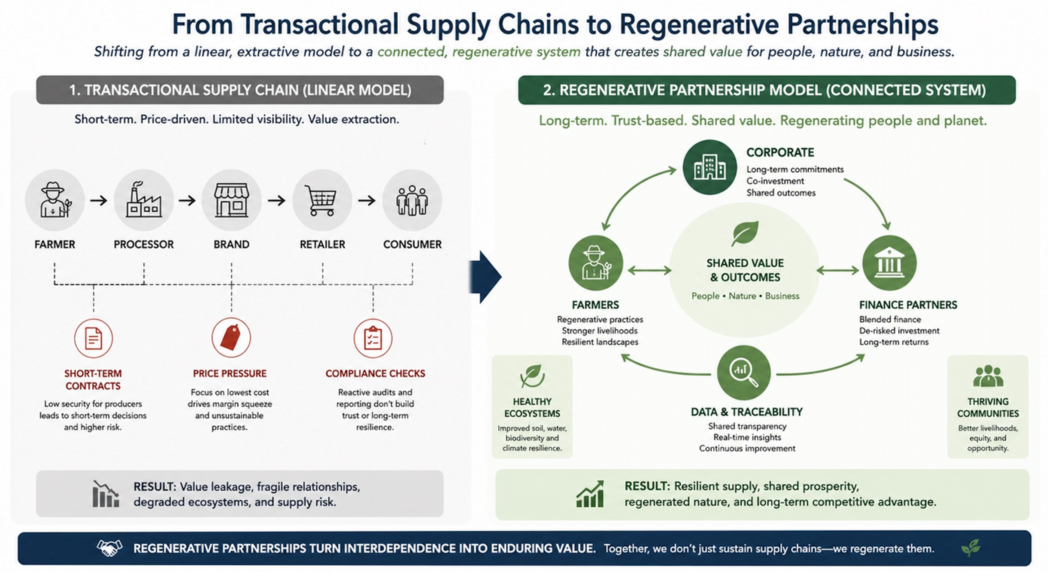
Most of our current systems are structured like one-off games:
- Short-term contracts
- Price-driven decisions
- Limited transparency
In that environment, defection is rational. Suppliers cut corners. Buyers switch sources. Trust erodes.
Regenerative partnerships flip this into a repeated game:
- Long-term agreements
- Shared visibility
- Mutual dependence
- Agreed-upon governance
This is what creates what I call the “stickiness factor.”
Partnerships don’t stick because of goodwill.
They stick because the structure
rewards cooperation and collaboration over time.
That’s the missing piece in many of our sustainability efforts today.
The Stickiness Factor in Practice
From what I’ve seen, three conditions make partnerships stick:
1. Shared incentives and shared risks
If only one side benefits and takes all the risk, the partnership will eventually break.
2. Long-term commitment
Short-term contracts undermine trust before it even takes shape.
3. Mutual accountability
Not just suppliers being measured, but buyers and all other intermediaries in the supply chain as well.
Organizations like The Nature Conservancy, Soil Capital, and IDH are experimenting with these multi-stakeholder models. They’re not perfect, but they are structurally aligned with what Axelrod showed decades ago: cooperation must be
designed and structured, not assumed.
What This Looks Like on the Ground
Let’s make this real with two practical examples.
Example 1: Coffee (System Under Stress)
In coffee, the imbalance is clear. Farmers carry most of the risk, while value is captured downstream.
A regenerative partnership model changes the structure:
- Buyers commit to multi-year sourcing agreements
- Farmers adopt regenerative practices (soil, biodiversity, water)
- Finance partners provide blended capital to de-risk transition
- Data systems enable traceability and verification
Organizations like Soil Capital are already linking financial incentives to these outcomes, and companies like Nespresso are putting this into action.
Example 2: Beef (System Rewiring)
In the beef sector, we’re seeing early models where:
- Ranchers are rewarded for soil carbon and land stewardship
- Corporations invest upstream to secure Scope 3 reductions
- Intermediaries coordinate landscape-level regenerative outcomes
What’s different here is not the practices - it’s the
alignment of incentives and risks across the chain.
From Pilots to Practice: What We Can Actually Do
Let’s be practical. If you’re sitting inside a company today, where do you start?
1. Redesign contracts as relationships
Move from annual sourcing cycles to multi-year agreements tied to sharing outcomes and benefits, not just volume.
2. Co-invest upstream
If resilience matters, invest where it’s created - on farms, in soil, in water systems, in socio-economic change.
3. Build transparency and traceability early
Traceability and transparency are not just reporting tools - it’s the foundation of trust.
4. Align internal teams
Procurement, finance, marketing, and sustainability must operate as one system. If they don’t, partnerships will fail externally.
5. Think in decades, not quarters
This is the hardest shift, and the most important.
A Final Thought
If there’s one thing I’ve come to appreciate, it’s this:
Regenerative partnerships are not about being idealistic.
They are about being realistic and practical about how systems behave over time.
Axelrod showed us that cooperation is not automatic. It emerges when conditions are right, and we must strive to create these healthy conditions. They do not automatically present themselves.
They require patience. Trust. A willingness to rethink how value is created and shared.
But they also offer something that our current systems struggle to deliver - resilience.
Right now, most supply chains are not set up for cooperation and collaboration.
They are set up for optimization.
And that’s the shift we need to make.
- From optimization to regeneration.
- From transactions to relationships.
- From short-term gain to long-term resilience.
For me, that’s the real promise here.
We’re not just improving supply chains. We’re redefining them - moving from systems that extract value to systems that regenerate it.
And in an increasingly uncertain world, that feels less like an option and more like a necessity.
About the Author: Nitesh Dullabh is the CEO and Founder of 2POD Ventures. He designs, structures, and lead public–private–philanthropic partnerships to strengthen supply chain resilience and accelerate regenerative change across value chains. His work is rooted in a simple philosophy: economic and financial growth must advance in step with planetary health and community wellbeing. Over the past 25 years, across South Africa, China, and the United States, Nitesh has worked at the intersection of strategy, systems thinking, and cross-sector leadership to tackle complex sustainability and climate challenges. He is also an adjunct professor at the Presidio Center for Sustainable Solutions at the University of Redlands and teaches Multi-sector Strategic Partnerships.
Images: 2POD Ventures
Read perspectives from the ISSP blog