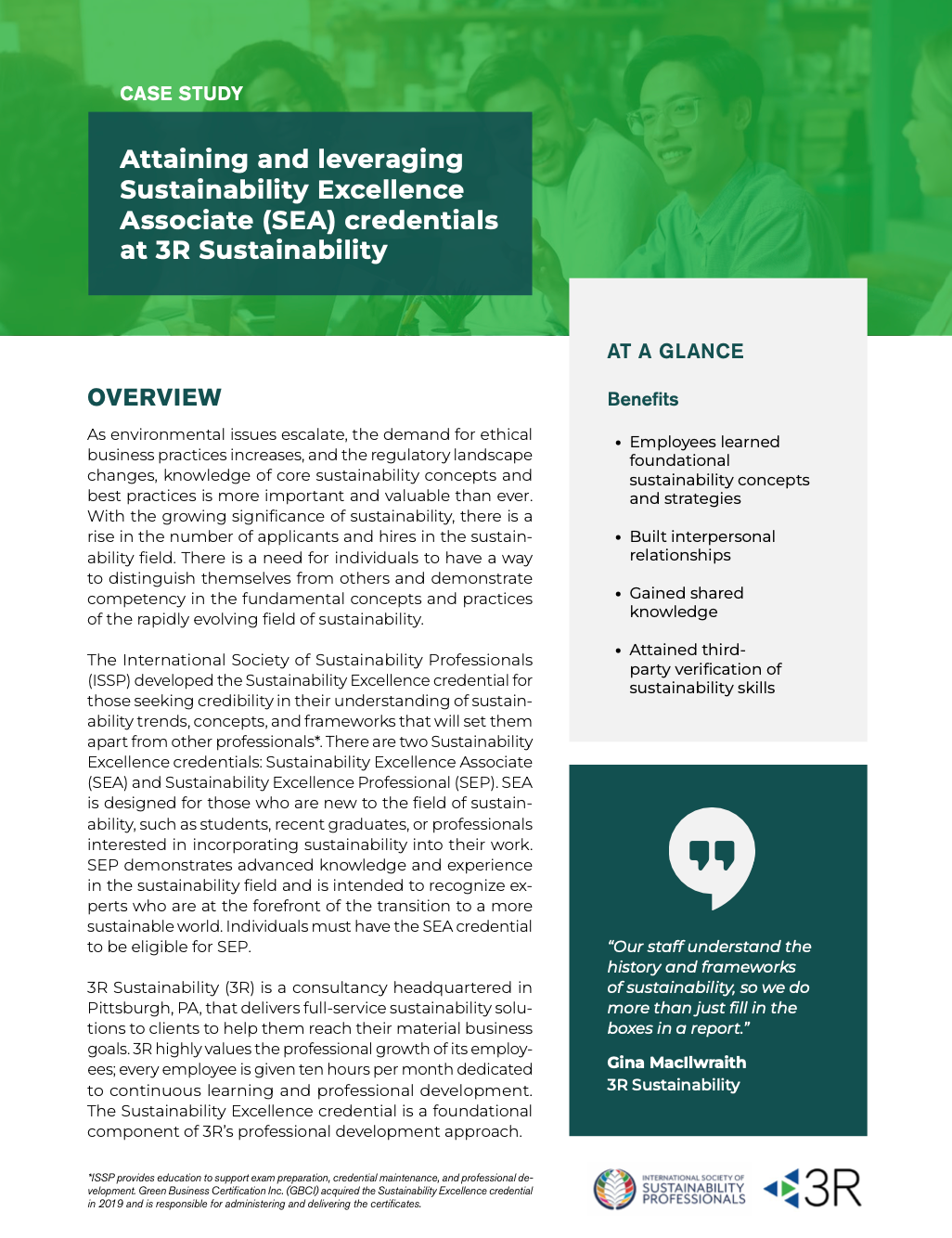
SEA Case Study: Interview with 3R Sustainability

The next SEA Study Cohort starts soon! Sign up to receive 12 one-hour study sessions and stay on track with your exam preparation.

Recently, we interviewed Gina MacIlwraith, MBA, SEP about the importance of continuous sustainability education and the value of the Sustainability Excellence credentials in the competitive consulting industry.


Gina is the Associate Director of Sustainability Assurance at
3R Sustainability, which is a women-owned business providing consulting services rooted in science, supported by data, and driven by innovation, education, and continual improvement. 3R delivers full-service sustainability solutions to their clients to achieve material business goals. Previously, Gina served as the General Manager of ISSP for almost four years, and she earned both her SEA and SEP credentials. Now she promotes study cohorts among her team at 3R, which has resulted in over 30 colleagues completing the SEA exam and over 75 colleagues completing the cohort training.


You can learn more about this work by downloading the free 2024 case study on Attaining and Leveraging SEA Credentials.
Why does 3R require the Sustainability Excellence credentials for your team? 


The reason we require the credentials is because it’s the best way to ensure our team members all have a consistent foundational understanding of ESG principles. Also, in consulting specifically, it is key to have a credential for third-party verification. You can earn other specific credentials, but this is the only one that demonstrates the foundations of a sustainability professional. So it gives us a step up as a consulting company to say that our entire team has a common understanding of the globally accepted fundamentals of sustainability. This is important right now, in particular as sustainability is both growing and becoming more and more controversial at times. Our staff understands the history and frameworks of sustainability – the why and where it came from, so we do more than just fill in the boxes in a report. 


Tell us more about the process for getting your team and interns credentialed. What does this look like for your team as far as resources and time? 


We’ve now done our study cohort six times. After last spring’s cohort with full-time employees, one team member commented that along with learning the fundamentals of our profession, employees were really able to bond and create interpersonal connections when studying together. It gives us a common language. 


For example, we bonded over John Elkington, and we were joking about getting John Elkington tattoos. Then, it seemed everybody had a John Elkington question on their [SEA] exam. We've got this group of employees who are hybrid or remote, and so we do sometimes have a hard time finding commonalities, but these cohorts give us something that's very work-related, but also very employee-engaging. 


And the truth is, when we do these cohorts, we very rarely study for it. The time is focused on interesting discussions about sustainability, what's going on in the world currently, and how this knowledge applies. So really, the SEA handbook is more than a study guide. It gives you an incredible framework for having conversations around sustainability. 


How do you fit the investment in credentialing into your overall business strategy?


Every employee at 3R gets 10 hours each month of continuing education professional development. This is at the core of our business because sustainability is changing so fast. We all need our 10 hours to keep up with everything. 


It’s also a commitment that Jana and I have made because it helps us better advise our clients. It just makes us better. Honestly, my tagline or my joking value proposition on business development calls is that I read the newsletters so you don’t have to. I sit through all those webinars, so you don’t have to. That’s how we help our clients, and the SEA is another piece of that. 


Do you have a specific example or a story that demonstrates how a staff member utilized the knowledge from their SEA or SEP to improve a client project?


When it comes to the SEP credential, we do it every day. That's our process. There's just two of us that have enough experience to qualify for the SEP, but the truth is that the SEP process is what we do with every one of our clients. We do materiality, we do stakeholder engagement, we create sustainability plans, and we do change management. 


For those starting out in the sustainability field, do you have any advice for them? 

Sustainability is an umbrella term; it’s rich in history. Understanding the full scope that can be included in the term is critical to success. The SEA credential gives practitioners the context to know how the field has evolved, along with the topics and issues that our profession can be tasked with as evidence of change.


Read perspectives from the ISSP blog

By By Elizabeth Dinschel & Bangaly Kourouma January 16, 2026
January 16, 2026 At the International Society of Sustainability Professionals (ISSP), strategy is not theoretical. It is practical, action-oriented, and grounded in the real needs of sustainability professionals working in complex and rapidly evolving environments. The ISSP 2026 Strategic Plan is a one-year, execution-focused roadmap designed to strengthen ISSP’s role as a global professional association for sustainability practitioners. Built directly from member feedback gathered through Town Halls, surveys, and ongoing conversations, the plan focuses on three strategic priorities: financial stability, relevant professional knowledge, and meaningful member engagement. This article explains what the 2026 Strategic Plan is, why these priorities matter, and how member input directly shaped ISSP’s direction. What the ISSP 2026 Strategic Plan Is—and Is Not The 2026 Strategic Plan is not a long-term vision statement or a five-year forecast. It is a focused, one-year plan designed to deliver measurable progress. The plan is intended to: Strengthen ISSP’s financial sustainability Modernize sustainability education and credential resources Improve the member experience across career stages Each priority includes defined actions, timelines, and success metrics, ensuring accountability and transparency.
Paper cut-out figures holding hands in a chain against a dark blue background.
By Elizabeth Dinschel, December 18, 2025 December 18, 2025
Elizabeth Dinschel, MA, MBA, is the Executive Director of ISSP Earlier this month, we hosted our first global ISSP Town Hall since I stepped into the role of Executive Director. I logged off that call energized, humbled, and deeply grateful for the honesty, generosity, and care that our members brought into the space. This Town Hall was never meant to be a one-way update. It was designed as a listening session — a chance for ISSP leadership and staff to hear directly from sustainability professionals across regions, sectors, and career stages. And you delivered. What follows are a few reflections on what I heard, what we learned, and where we’re headed next together. Why We Called This Town Hall ISSP has gone through a period of transition — new leadership, new staff, and a renewed focus on modernizing how we serve a truly global membership. Change can be energizing, but it can also create moments of uncertainty and disconnection. We knew we needed to pause, gather our community, and listen with intention. The Town Hall brought together members from multiple continents, industries, and disciplines. Sustainability practitioners, consultants, engineers, communicators, policy professionals, and career-transitioners all showed up with thoughtful questions and candid feedback. One thing was immediately clear: this community cares deeply about its work, about each other, and about ISSP’s role in supporting sustainability professionals at a challenging moment for the field.
Can sustainability be saved by tackling loneliness, not just CO₂ emissions?
By Raz Godelnik, Associate Professor November 20, 2025
Raz Godelnik is an Associate Professor of Strategic Design and Management at Parsons School of Design — The New School. He is the author of Rethinking Corporate Sustainability in the Era of Climate Crisis . You can follow him on LinkedIn .  Can sustainability be saved by tackling loneliness, not just CO₂ emissions? Earlier this month, I stopped at Sunshine Coffee in Laramie, Wyoming, on our way to Yellowstone Park. What brought me there was the fact that it’s a zero-waste coffee shop, with no single-use consumer items. In other words, there are no disposable cups — not for customers dining in, and not even for those who want their coffee to go, like I did. Instead, you can either bring your own reusable cup or get your drink in a glass jar for $1, which is refunded on your next order when you return it (or you can simply keep it, as I did). At first, I was excited about the zero-waste coffee shop concept, wondering what it would take for Starbucks and other coffee chains to adopt it and eliminate the waste that has become an integral part of our coffee (and other drinks) consumption. But as I waited for my coffee, I began to notice something else — something that had little to do with waste and everything to do with people. As I looked around, I noticed their stickers. Beneath the logo, it read: Zero waste. Community space . Suddenly it clicked — this coffee shop isn’t just about eliminating waste; it’s about creating a place where people feel connected. As owner and founder of Sunshine Coffee, Megan Johnson, explained in an interview with This is Laramie : “I wanted to bring sustainable values to Wyoming as well as build a business that serves the community.” That got me thinking about how the second part — serving the community — is integral to the first. After all, in a world where loneliness — a key barrier to people’s well-being — is on the rise, shouldn’t creating spaces for connection be just as central to sustainability as going zero waste?
More blog posts