What brought you to this moment in your career where the Sustainability Excellence Associate (SEA) made sense for you?
I have had a passion for the field of sustainability since I studied at Sebelas Maret University (UNS) majoring in Biology, so this SEA credential has become one of my targets since I started my career journey in community development, environmental management, solid waste management, sustainable development, and etc.
I earned SEA credential at the end of October 2022, and this credential supports my work as Head of the Environmental Practices Department, where I am still conducting some review for the framework and strategy of sustainability that has been planned and implemented by Sinar Mas Land.
Today, I am maintaining and developing knowledge and practical experience on sustainability through networking with sustainability experts and joining a sustainability community like ISSP Indonesia. Also, I am continuing to renew the SEA credential through joining webinars and courses that are provided by ISSP.
How are you putting the knowledge, skills, and ability demonstrated in the SEA to work in your career (or work) today?
I realize that sustainability does not only focus on one aspect, but it is comprehensive, and business activities can contribute to a sustainable environment and the creation of social equity and community welfare. So I still read the SEA study guide and take part in webinars, courses, and workshops that support my plan to provide recommendations on the implementation of sustainability to the companies and my colleague in environmental consultant and NGOs.
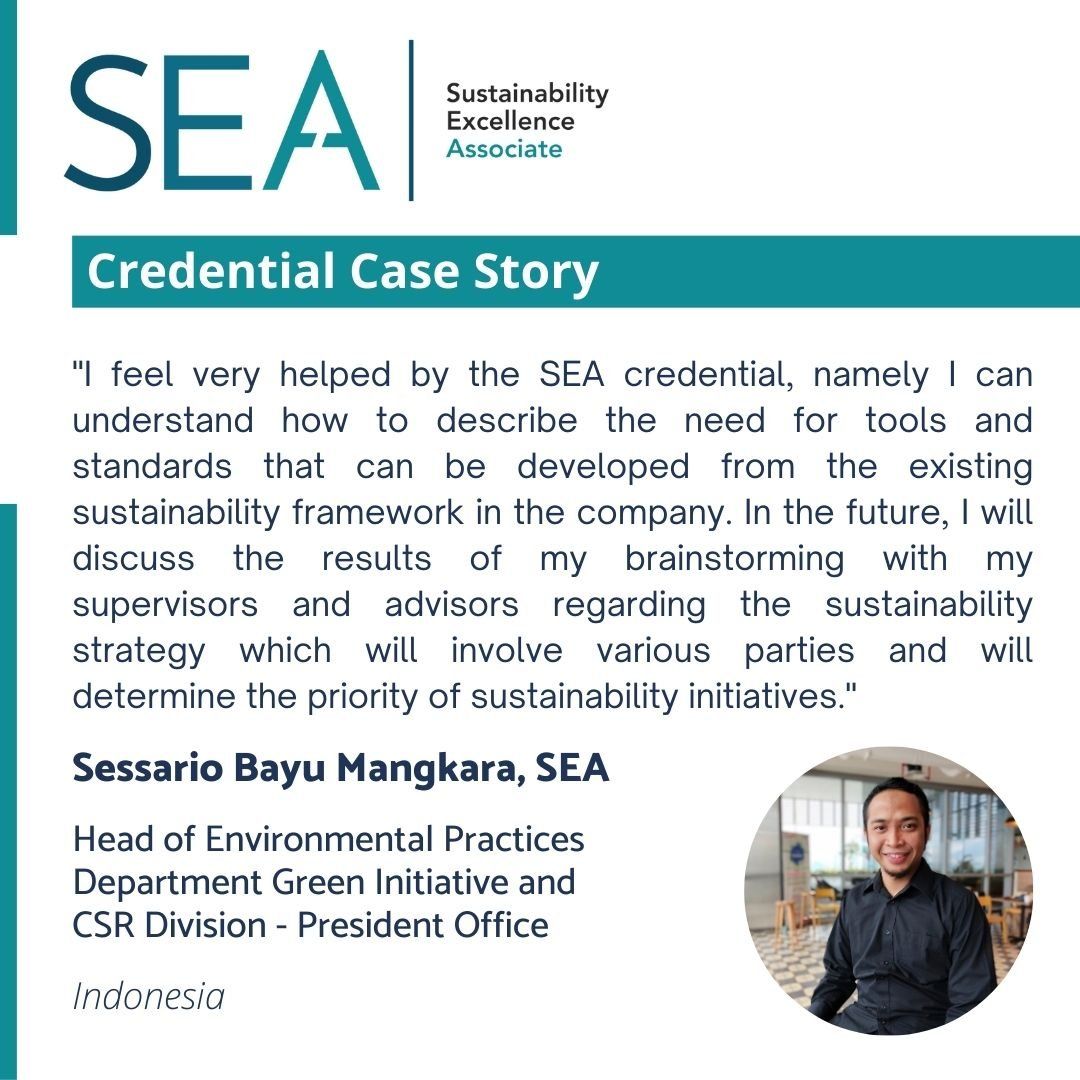
I feel very helped by the SEA credential, namely in that I can understand how to describe the need for tools and standards that can be developed from the existing sustainability framework in the company. In the future, I will discuss the results of my brainstorming with my supervisors and advisors regarding the sustainability strategy, which will involve various parties and will determine the priority of sustainability initiatives.
What advice do you have for newcomers to this sustainability work?
The SEA credential is not only to gain recognition that we understand the definition of the sustainability. However, as a sustainability professional we have to provide an appropriate recommendation for implementing the sustainability initiatives that we initiate both in companies and in the communities and or associations that we already joined.
After earning the SEA credential, I still read articles and inspiration to review my understanding in dealing with a case study to create a sustainability strategy. The other advice I’d give to newcomers is to maintain the foundation knowledge of sustainability by creating a sharing session to your colleagues in the companies or in the community impacted by sustainability. Also, broaden your network through webinars, seminars, workshops, etc., as these are places where you will find sustainability practitioners and get new insights regarding the sustainability initiatives that you have implemented.What brought you to this moment in your career where the Sustainability Excellence Associate (SEA) made sense for you?
My professional role fairly quickly became at least part time sustainability focused, as my company recognized it is where my passions lie, and the firm wished to further reduce their footprint. I found the SEA certification to help build my credibility in sustainability. Being backed by the GBCI, it seemed like the perfect cert. to add to my resume. I appreciated that it covered a wide range in sustainability topics and left me feeling confident in my sustainability knowledge as I brought it back to my career.
How are you putting the knowledge, skills, and ability demonstrated in the SEA to work in your career (or work) today?
The history sections of the SEA have been useful as I continue my sustainably work. It’s important to understand where sustainability has come from, to help guide it to where we need it to be. Overall, the SEA provided me with a solid base of knowledge that I hold in my back pocket while coordinating sustainability efforts. I am now more aware of the tools we hold to help us combat climate change, which helps know where we can start implementing further change. In my environmental consulting firm, many other employees have similar master’s degrees to the one I’m working towards (Master of Science in Env. Management and Policy, emphasis in energy and sustainability) so the SEA helps set me apart. It may only seem like a small way to set me apart, but anything helps in this competitive industry!
For those starting out in the sustainability field, what advice do you have for them?
I feel like I am almost still starting out in the sustainability field, but I would recommend that you be loud about your passions and have the knowledge to back it up! I was hired on as a marketing specialist, simply happy to be joining the environmental industry. Within months my role morphed into a mix of marketing and sustainability responsibilities, including managing company-wide green initiatives. I don’t think this would have become my reality, at least not as quickly, if I had not brought my passion to the table. When you do get the green light to implement sustainability initiatives, you should be prepared to make the business case for it as well. While everyone wants to do what’s right, companies need to make revenue, so come with an impenetrable plan that makes sense for the business and the planet.