Joseph K. Muiruri - SEA Case Story

About Joseph:  Dr. Joseph K. Muiruri obtained his Ph.D. in Material Science and Engineering (MSE) from the National University of Singapore (NUS). He has a master’s degree in Environmental Planning & Management from the University of Nairobi, Kenya. Previously, Joseph worked as a research scientist for 10 years and as the Head of the Textiles division for 2 years at the Kenya Industrial Research and Development Institute (KIRDI). Currently, he is a Senior Scientist I at the Institute of Sustainability for Chemicals, Energy and Environment (ISCE2) A*STAR. Sustainable biopolymers for packaging, natural fibre composites for high-end applications, circular economy, and sustainability metrics are among his research interests.View his member profile in the directory.

What brought you to this moment in your career where the Sustainability Excellence Associate (SEA) made sense for you?


My journey to this point in my career has been shaped by a deep commitment to sustainability, a passion for environmental responsibility, and a desire to make a meaningful impact on society. It all began in 2004 when I took my first step into the environmental field as a Health and Safety Officer. This role sparked my interest in understanding the relationship between human activities and environmental impacts, laying the foundation for my academic and professional path.


In 2011, I pursued a master's degree in Environmental Planning and Management, which allowed me to develop a stronger grasp on sustainable practices and solutions. Following my graduation, I worked as a Research Scientist, focusing on the value addition of natural materials, especially banana stems, which deepened my understanding of how underutilized resources can be transformed into valuable products in a sustainable manner.


In 2019, I earned a PhD in Materials Science and Engineering from the National University of Singapore, where I specialized in biopolymers and sustainable materials. My research revolved around closing the loop in resource use and creating innovative solutions to replace conventional plastics with biodegradable alternatives. This work further ignited my passion for creating sustainable materials for industries like packaging and cosmetics, aligning perfectly with the goals of the Institute of Sustainability for Chemicals, Energy, and Environment (ISCE2), where I began working in 2021. In this role, I apply my expertise to the development of biopolymers, biosolvents, and other sustainable solutions aimed at creating a circular economy in industries.


The Sustainability Excellence Associate (SEA) role felt like the natural next step in my career. The SEA's focus on creating impact through sustainability practices resonates with my long-standing commitment to sustainability. It allows me to apply my diverse background in environmental management, material science, and research to help drive forward real-world solutions to environmental challenges.


How are you putting the knowledge, skills, and ability demonstrated in the SEA to work in your career (or work) today?


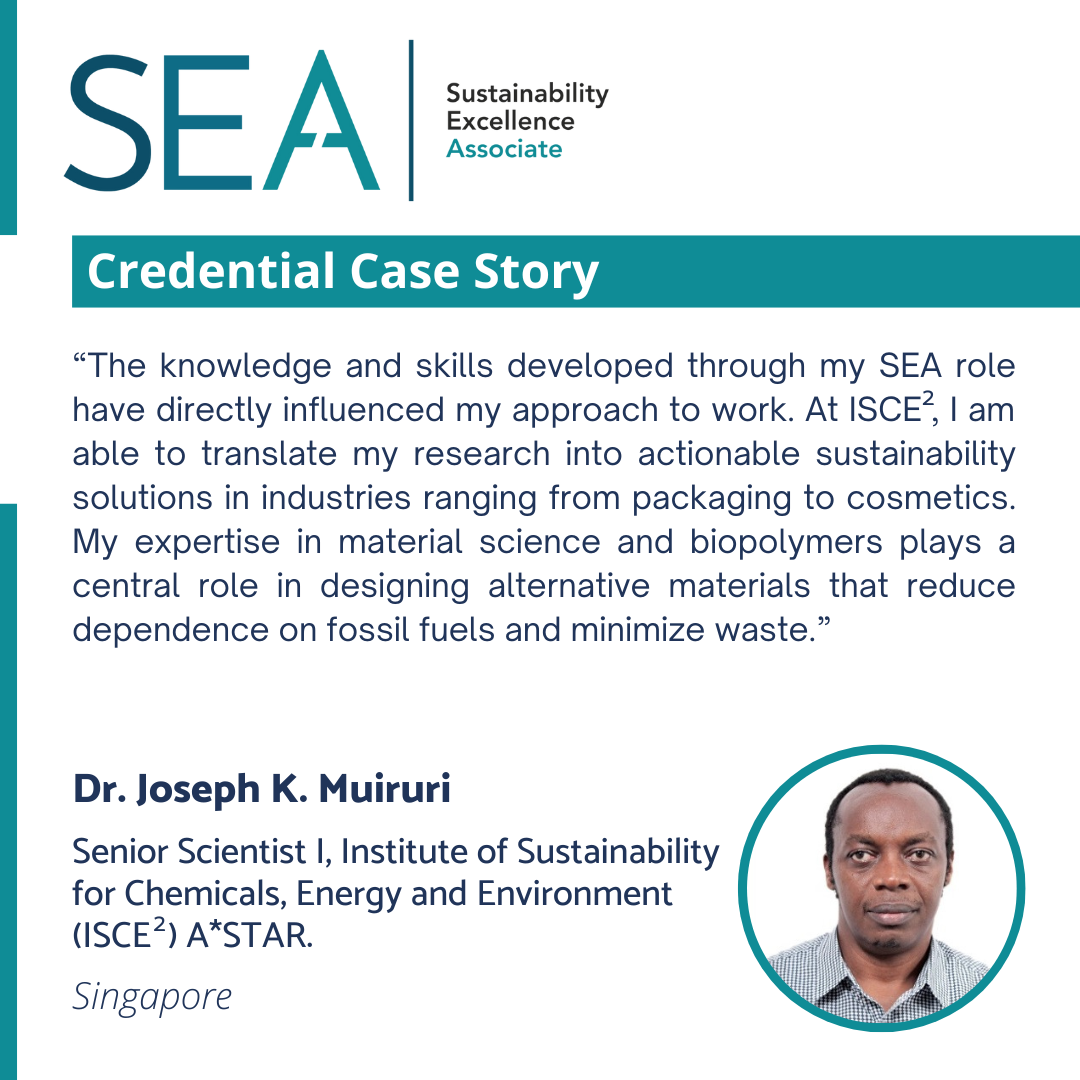
The knowledge and skills developed through my SEA role have directly influenced my approach to work. At ISCE2, I am able to translate my research into actionable sustainability solutions in industries ranging from packaging to cosmetics. My expertise in material science and biopolymers plays a central role in designing alternative materials that reduce dependence on fossil fuels and minimize waste. I am continuously involved in interdisciplinary projects aimed at developing biobased solutions that promote circularity and reduce environmental impact.


The SEA framework has provided me with a clearer understanding of how to assess sustainability from both a strategic and operational perspective. It enables me to navigate complex challenges, such as scaling up sustainable processes and ensuring that new materials are not only eco-friendly but also economically viable for industries. The strategic mindset developed through SEA is crucial in aligning scientific research with business goals, ensuring that sustainability goals are integrated across the supply chain.


For those starting out in the sustainability field, what advice do you have for them?


For those new to sustainability, stay curious and keep learning. Stay updated on emerging research, technologies, and practices. A well-rounded understanding of sustainability’s environmental, economic, and social aspects is essential. Collaborate across disciplines, and be patient—progress may be gradual, but each step moves us toward a more sustainable future. 

Interested in earning your SEA credential? Download our free sample of the SEA Study Guide or sign up for the next SEA Study Cohort.

Read perspectives from the ISSP blog

By By Elizabeth Dinschel & Bangaly Kourouma January 16, 2026
January 16, 2026 At the International Society of Sustainability Professionals (ISSP), strategy is not theoretical. It is practical, action-oriented, and grounded in the real needs of sustainability professionals working in complex and rapidly evolving environments. The ISSP 2026 Strategic Plan is a one-year, execution-focused roadmap designed to strengthen ISSP’s role as a global professional association for sustainability practitioners. Built directly from member feedback gathered through Town Halls, surveys, and ongoing conversations, the plan focuses on three strategic priorities: financial stability, relevant professional knowledge, and meaningful member engagement. This article explains what the 2026 Strategic Plan is, why these priorities matter, and how member input directly shaped ISSP’s direction. What the ISSP 2026 Strategic Plan Is—and Is Not The 2026 Strategic Plan is not a long-term vision statement or a five-year forecast. It is a focused, one-year plan designed to deliver measurable progress. The plan is intended to: Strengthen ISSP’s financial sustainability Modernize sustainability education and credential resources Improve the member experience across career stages Each priority includes defined actions, timelines, and success metrics, ensuring accountability and transparency.
Paper cut-out figures holding hands in a chain against a dark blue background.
By Elizabeth Dinschel, December 18, 2025 December 18, 2025
Elizabeth Dinschel, MA, MBA, is the Executive Director of ISSP Earlier this month, we hosted our first global ISSP Town Hall since I stepped into the role of Executive Director. I logged off that call energized, humbled, and deeply grateful for the honesty, generosity, and care that our members brought into the space. This Town Hall was never meant to be a one-way update. It was designed as a listening session — a chance for ISSP leadership and staff to hear directly from sustainability professionals across regions, sectors, and career stages. And you delivered. What follows are a few reflections on what I heard, what we learned, and where we’re headed next together. Why We Called This Town Hall ISSP has gone through a period of transition — new leadership, new staff, and a renewed focus on modernizing how we serve a truly global membership. Change can be energizing, but it can also create moments of uncertainty and disconnection. We knew we needed to pause, gather our community, and listen with intention. The Town Hall brought together members from multiple continents, industries, and disciplines. Sustainability practitioners, consultants, engineers, communicators, policy professionals, and career-transitioners all showed up with thoughtful questions and candid feedback. One thing was immediately clear: this community cares deeply about its work, about each other, and about ISSP’s role in supporting sustainability professionals at a challenging moment for the field.
Can sustainability be saved by tackling loneliness, not just CO₂ emissions?
By Raz Godelnik, Associate Professor November 20, 2025
Raz Godelnik is an Associate Professor of Strategic Design and Management at Parsons School of Design — The New School. He is the author of Rethinking Corporate Sustainability in the Era of Climate Crisis . You can follow him on LinkedIn .  Can sustainability be saved by tackling loneliness, not just CO₂ emissions? Earlier this month, I stopped at Sunshine Coffee in Laramie, Wyoming, on our way to Yellowstone Park. What brought me there was the fact that it’s a zero-waste coffee shop, with no single-use consumer items. In other words, there are no disposable cups — not for customers dining in, and not even for those who want their coffee to go, like I did. Instead, you can either bring your own reusable cup or get your drink in a glass jar for $1, which is refunded on your next order when you return it (or you can simply keep it, as I did). At first, I was excited about the zero-waste coffee shop concept, wondering what it would take for Starbucks and other coffee chains to adopt it and eliminate the waste that has become an integral part of our coffee (and other drinks) consumption. But as I waited for my coffee, I began to notice something else — something that had little to do with waste and everything to do with people. As I looked around, I noticed their stickers. Beneath the logo, it read: Zero waste. Community space . Suddenly it clicked — this coffee shop isn’t just about eliminating waste; it’s about creating a place where people feel connected. As owner and founder of Sunshine Coffee, Megan Johnson, explained in an interview with This is Laramie : “I wanted to bring sustainable values to Wyoming as well as build a business that serves the community.” That got me thinking about how the second part — serving the community — is integral to the first. After all, in a world where loneliness — a key barrier to people’s well-being — is on the rise, shouldn’t creating spaces for connection be just as central to sustainability as going zero waste?
More blog posts